

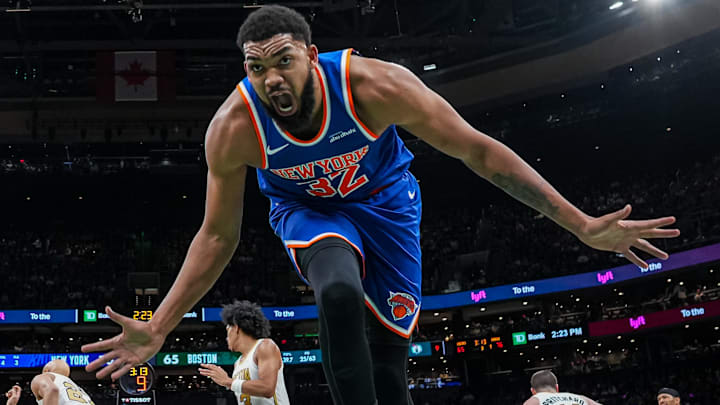
After nearly two seasons’ worth of tunnel vision when going downhill, Karl-Anthony Towns is now passing more frequently out his drives. The New York Knicks and their fans should react accordingly—which is to say, they’re free to re-enact the fire drill clip from Season 5, Episode 13 of The Office.
Oh, my God! Okay, it's happening. Everybody stay calm. Everybody stay calm!
Frankly, you’ll be forgiven if you do not remain calm. This is exciting for a multitude of reasons, provided the trend holds.
Karl-Anthony Towns is passing waaaaay more of drives
Let’s start with the specifics on the trend itself, as The Strickland contributor @_prezidente pointed out following the Knicks’ Sunday victory over the San Antonio Spurs.
Prior to the All-Star break, Towns was passing on 16.8 percent of his drives, and racking up an assist 4 percent of the time. Among 92 players finishing as many downhill attacks per game, these passout and assist rates ranked 90th.
The tables have turned—or perhaps more aptly, the ball has sprayed in different directions—since the Knicks came out of the All-Star break. Over the past six games, Towns has basically doubled both marks, passing on 33.8 percent of his drives, and notching an assist 9.5 percent of the time.
Granted, the passout rate isn’t exceptionally high relative to the masses. It ranks 53rd out of 88 players averaging as many drives per game post-All-Star-break. But this still qualifies as a major improvement. Plus, Towns’ 9.5 assist rate clocks in at an even more impressive 38th overall.
This is a career-long issue for KAT
Really, this isn’t about pitting him against a larger field. It’s about Towns competing against himself. Look at his full-season passout rates over the past seven years (the percentile ranks come courtesy of Bball Index):
- 2025-26: 17.1 percent (15th percentile)
- 2024-25: 11.85 percent (9th percentile)
- 2023-24: 19.46 percent (15th percentile)
- 2022-23: 25.00 percent (25th percentile)
- 2021-22: 24.57 percent (24th percentile)
- 2020-21: 22.50 percent (24th percentile)
- 2019-20: 26.57 percent (35th percentile)
Even when Towns registers as a more frequent passer, it’s never in high volume. That is by and large fine. A seven-footer with his meld of physicality and ball skills should look to score when putting it on the deck.
One-track mindedness lends itself to predictability, though. Certain players are such forces of nature that it doesn’t matter. Towns is sometimes among them. Out of the 248 players who have finished at least 100 drives, his 0.87 points scored per drive ranks ninth.
Still, this isn’t groundbreaking efficiency overall. The value of drives inflates exponentially when you’re a threat to spray out the ball to shooters, or dump it off to players cutting toward the basket.
The Knicks are going to be a problem if this KAT trend sticks
Towns should be uniquely equipped to punish defenses in these situations. The attention he draws when going downhill remains bonkers. It is a minimum of two-to-the-ball when he’s attacking step-for-step, and skews toward three-to-the-middle if he has his man beat.
To that end, even though he’s not a high-volume dimes guy out of drives, the quality of opportunities he can set up is through the roof. In each of the previous two seasons, Towns has rated inside the 85th percentile or better in the share of his passes out of drives that resulted in an assist, according to BBall Index.
Just as importantly, when Towns is deferring on his drives, it renders him far less likely to end a possession complaining about a no-call at the rim. As any Knicks fan knows, this is an issue that more-than-occasionally torpedoes the defense. They rank 29th in points allowed per possession after a miss at the basket. That isn’t entirely KAT’s fault, but given that he’s missed more shots at the rim than anyone on the team, weeding out instances in which he falls out of frame while, let’s say, stating his case to the refs would be a huge deal.
It’s much too early to declare this trend a new normal. That it’s a trend at all, though, matters more than anything. At the bare minimum, it is proof Towns hears criticism, and is willing to adjust. At best, it’s a path toward maximizing his impact on the offense—both when he’s scoring, and more critically, even when he’s not.
Put another: Oh, my God! Okay, it's happening. Everybody stay calm. Everybody stay calm!
 Add us as a preferred source on Google