

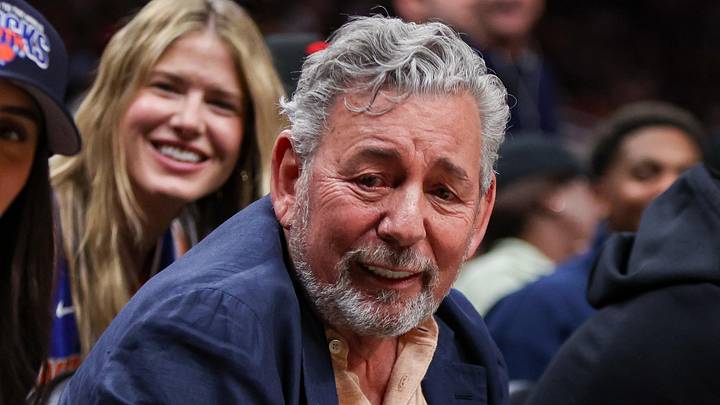
Billionaire killjoy James Dolan caused quite a stir when he said the New York Knicks would not enter the second apron as they plan their championship defense. The merits of this stance aren’t debatable, because it has no merits. By making these comments, though, Dolan may have just disclosed to the world that New York is hanging on to both the No. 24 and No. 31 picks in the 2026 NBA draft.
This runs in contrast to previous reporting. Sources told Jake Fischer over at The Stein Line that the Knicks will probably trade away at least one of their first two picks. (They also own No. 55.)
Dealing one of those selections if New York is more focused on adding veterans makes sense. First-year players have a tough time racking up meaningful reps for title contenders. Mohamed Diawara had a standout rookie campaign relative to his draft position (No. 51), and his utility maxed out before the playoffs.
Still, if the Knicks are serious about staying out of the second apron, they desperately need to collect cheap players who can contribute in the short and long terms. And that should necessitate hanging onto both No. 24 and No. 31.
Keeping draft picks helps with the second-apron gymnastics
First thing’s first: New York’s official stance on the second apron isn’t yet totally clear. Dolan could have misspoke. He could have been sending up a smokescreen. In the event he was being honest, the Knicks will, at minimum, bid farewell to Michell Robinson, and then at least one of Landry Shamet, Jose Alvarado, and Diawara.
That reality is unsettling. And unacceptable. But if it’s the path New York travels down, it can potentially add two useful players for a combined $5 million next season.
Right now, the No. 24 pick is projected to earn around $3.3 million in 2026-27. While the 31st selection does not have a predetermined scale, if we use last season’s choice as a baseline (Rasheer Fleming), the Knicks might be able to sign whomever they grab to a rookie-minimum salary of about $1.4 million.
Mash them together, and this comes out $4.7 million for two first-round-caliber prospects. Meanwhile, if New York replaces those slots with standard minimums for veterans having two or more years of experience, it’ll run $2.45 million worth of cap hits apiece. That’s a total of $4.9 million.
A $200,000 or so difference doesn’t seem like much. But the Knicks carved out championship depth by navigating these wafer-thin margins. Remember, they finished within $240,000 of the second apron this past season.
The Knicks can save even more money by working their usual magic
This increased need for cost-controlled talent doesn’t preclude the Knicks from trading one or both of these picks. But it should mean they plan on retaining two selections within the same range.
Team president Leon Rose and company are among the league’s most resourceful draft-night movers and shakers. If the first-round prospect they’re eying can be had a couple of picks later, they’ll have the chance to create more flexibility.
Let’s say whomever they want at No. 24 will be on the board at No. 29. If they trade down with the Cleveland Cavaliers, that $3.3 million cap hit for No. 24 drops to $3 million. The Knicks also probably get another tiny asset for sliding down, too.
Prospective savings can rise further if New York’s preferred target is still around at the top of the second round. Trading No. 24 for the Memphis Grizzlies’ No. 32 pick (and another second) would save the Knicks $1.9 million, bringing their totals for 31st and 32nd overall to a projected $2.8 million combined. That’s a noticeable difference from the current forecasted aggregate cost of $4.7 million.
Frankly, none of this validates New York’s possible second-apron aversion. Refusing to enter it would be a farce under the circumstances. But if Dolan was telling the truth, then he potentially, if not likely, provided a window into how the Knicks will approach—and transact during—the draft.
 Add us as a preferred source on Google