

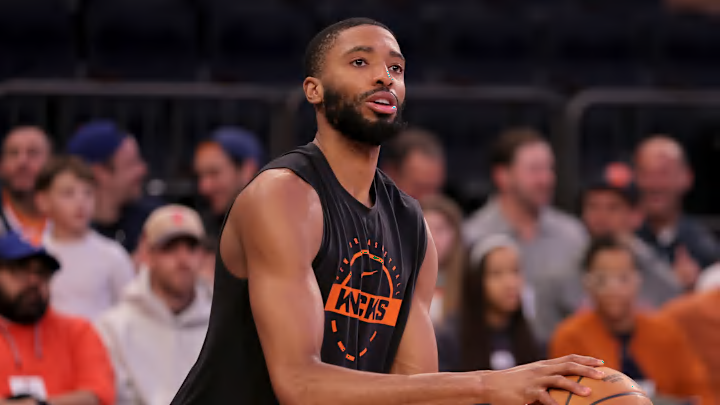
New York Knicks standout Mikal Bridges has become a surprisingly polarizing figure during the 2025-26 season. He's made statistical progress in almost every area, yet many seem to insist that he's having something of a down year.
Influenced by the price the Knicks paid to acquire Bridges and the possibly miscast role he's been entrusted on defense, the narrative has been equal parts confusing and compelling.
Statistically, Bridges has made widespread improvements between 2024-25 and 2025-26. From a volume perspective, he's increased his averages by 1.3 rebounds, 0.6 assists, 0.6 steals, 0.4 blocks, and 0.2 three-point field goals made per 36 minutes.
Bridges has also improved his efficiency by 2.6 percent from beyond the arc and 1.3 percent at the free throw line, thus implying improved overall quality.
In fact, Bridges is on pace to post his best three-point field goal percentage since 2022-23. On a per-36 basis, he's averaging his most steals since 2019-20, his most blocks since 2020-21, the highest assist mark of his entire eight-year career, and his second-most three-point field goals made.
The question is: Is the criticism of his overall quality really as simple as the fact that Bridges is scoring fewer points per game and per 36 minutes? The answer is partially yes, but not quite.
Mikal Bridges has improved in almost every statistical area but points
Bridges has found himself in a position that few around the NBA can relate to. He's surrounded by gifted scorers, including two All-NBA teammates in Jalen Brunson and Karl-Anthony Towns, and a rising scoring force in OG Anunoby.
That's inevitably created an environment in which even one supporting player having a strong scoring night can task Bridges with finding other areas to prioritize.
The same occurs on the defensive end of the floor. Bridges has played a direct role in establishing the Knicks as a defensive juggernaut over the past two months, but he's done so while playing what effectively amounts to outside of his comfort zone.
James L. Edwards III of The Athletic provided invaluable insight into the hurdles that Bridges has encountered on defense while being asked to play a role that doesn't necessarily suit him.
"However, because the bulk of Bridges’ minutes come as part of a starting lineup that has an elite off-the-ball defender in OG Anunoby and a roamer in Josh Hart, who is best at mucking things up for offenses, Bridges often takes on the role of guarding the primary ballhandler to fill the gap as the premier on-ball defender. That responsibility can highlight some of Bridges’ weaknesses, such as asserting himself as a physical presence while teams look to initiate their offense on that end of the court."
True as that all may be, the reality is simple: Bridges is still making a positive impact on the game despite being asked to play a style on both ends of the floor that isn't in line with his strengths.
Mikal Bridges positively influences winning despite perceived flaws
Bridges' scoring numbers are down, but the Knicks are averaging 3.9 more points per 100 possessions when he's on the court. He's playing a role that doesn't cater to his strengths on defense, but the Knicks have a team-best defensive rating of 105.2 when he's on the court since Jan. 20.
That may seem like an arbitrary date, but it was the day after the Knicks' ninth loss in 11 games—and they've since gone 16-7 while ranking No. 1 in the NBA in defensive rating.
The harsh reality facing Bridges is that the issue isn't with the impact he makes on team success. It's in the visibility of what he offers. He isn't scoring 20-plus points per game or making the type of highlight-reel defensive plays that will get him a spot on SportsCenter or whichever social media platform on which you consume basketball clips.
That simply doesn't mesh with the reality that the Knicks gave up five future first-round draft choices and a pick swap to acquire Bridges.
Mikal Bridges isn't always visible, but he's always making his mark
The truth about Bridges is that what was lost in the trade for him has caused many to overlook his importance. Questions have been asked about the outgoing package, with many noting that the Knicks could've used some of the picks they lost for him to acquire Giannis Antetokounmpo.
The question that those who pose that point seem to be refusing to ask: Would the Knicks have ended a 25-year Conference Finals drought had they not acquired Bridges?
Keep in mind: It was Bridges who made critical stops at the end of close games with the Boston Celtics and Detroit Pistons. It was also Bridges who scored a timely 20 points to give New York the 2-1 lead over Detroit—and then 25 to close the series out in Game 6.
Bridges then stepped up with 23 points and four steals in Game 4 against the Boston Celtics to give the Knicks a 3-1 series lead—and then scored 22 points in 30 minutes to close the series out.
If you're sensing a pattern, you're on to something. Bridges may never check the on-paper boxes to suggest he was worth one of the heftiest outgoing trade packages in NBA history, but he steps up when New York needs him most. That includes when it had lost nine games in 11 tries in 2025-26.
The enduring question Knicks fans and critics will need to answer moving forward is simple: Can you stop living in the past and acknowledge what Bridges does to elevate the Knicks in the present?
 Add us as a preferred source on Google