

In the NBA, 29 teams spend every offseason trying to become just a little bit more like the 30th — the reigning champions. When the New York Knicks lifted the 2026 Larry O'Brien Trophy up in June, their unconventional roster inherently (and immediately) became the latest iteration of the league's championship blueprint.
Teams can't necessarily just produce a superstar point guard or an All-NBA stretch five, their own versions of Jalen Brunson and Karl-Anthony Towns, out of thin air. They can, however, try to replicate the general construction of the Knicks' roster. It's exactly what the Cleveland Cavaliers are doing by acquiring Peyton Watson.
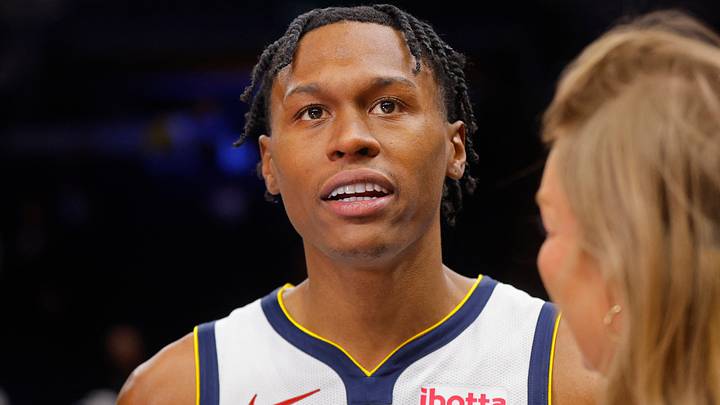
The wing, who turns 24 years old in September, doesn't profile exactly like any of the Knicks' wings. However, his size, athleticism, defensive instincts, and potential on both sides of the basketball make someone like OG Anunoby an interesting comparison — speaking optimistically — for the young restricted free agent. Trading Max Strus to give Watson a four-year, $88 million contract shows just how important this kind of addition was to the Cavaliers.
Brian Windhorst says Cavs' Peyton Watson move shows Knicks' influence
ESPN's Brian Windhorst discussed the Cavaliers' sign-and-trade for Watson on the latest episode of The Hoop Collective, going as far as to reveal that James Harden aided in the team's efforts to recruit the former Denver Nugget.
The titular host spoke to the importance and scarcity of two-way wings in an era of the NBA that puts versatility and switchability at such premiums. He also proved the Knicks hold the championship blueprint, at least for now. Windhorst referenced their pair of costly wing acquisitions, both in the past tense, as successful examples of "overpays" for two-way wings working out.
"The hardest thing to get in the NBA is athletic, two-way wings...That's why the Knicks paid so dearly to get Mikal Bridges and OG Anunoby...The Cavs think they got one in Watson and they think that Jaylon Tyson, who's their young rookie, can develop into a key, two-way wing,"
Windhorst told co-hosts Tim MacMahon and Dave McMenamin.
That's quite the change from the initial perception of those trades, particularly in the case of Mikal Bridges. Leon Rose's front office was not viewed favorably for surrendering more than five years' worth of draft capital for a complementary player who had never made an All-Star appearance. One NBA Championship later, the trades are being invoked as examples of brilliance.
Winning can solve plenty of problems. Whatever dollar amount the Cavaliers gave Watson — and point guard James Harden — this summer will end up aging flawlessly if the group is able to deliver a title of their own. If not, it'll be easy to look back on moves like this as the ones that helped limit Cleveland's flexibility and potential going forward.
 Add us as a preferred source on Google