

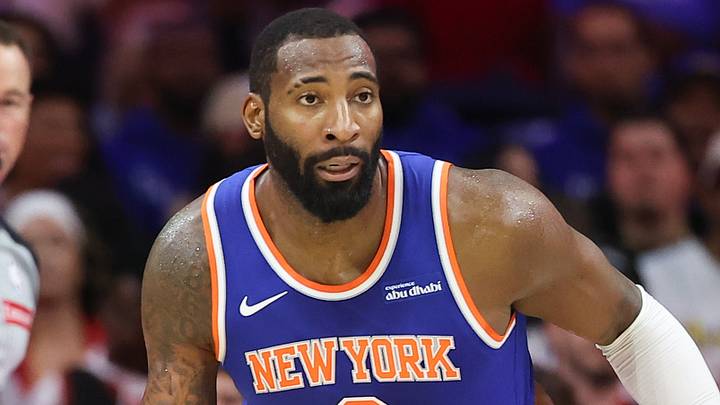
Andre Drummond is doing a fine job of approximating Mitchell Robinson’s offensive-rebounding volume from last season. He is having a much harder time, however, helping the New York Knicks score on their second-chance opportunities.
We don’t have to search far and wide for the reason, either. It’s clear as day. Painfully obvious, even.
Unlike Robinson, Drummond is more likely to chase his own shot after grabbing an offensive board. And when he does, it’s a victory for the defense.
The Knicks are not used to this kind of offensive rebounding
Drummond is grabbing 21.2 percent of the Knicks’ own misses whenever he’s on the floor. That is well within striking distance of the 23.9 percent mark Robinson notched last season.
The bigger difference is felt with what happens next. Drummond is averaging 24.3 field-goal attempts for every 36 offensive rebounds he grabs. This in itself isn’t a problem, so long as his shots are going in at a respectable clip.
They’re not.
The 33-year-old is shooting 44 percent from the floor on second-chance opportunities. That includes a ghastly 47.8 percent at the rim, where the league average is around 67.1 percent.
This is a stark contrast to how Robinson operated on the offensive glass. He was more inclined to kick the rock back out to a shooter, or someone who would immediately attack a now-tilted defense.
Robinson attempted just seven shots last season for every 36 offensive boards he snared. Drummond is throwing up more than three times as many. Now, this brand of low volume is an outlier for Mitch. But he didn’t sniff Drummond’s attempt rate even at his peak.
From 2021-22 all the way through last year, Robinsons averaged 18.8 shot attempts per 36 offensive rebounds. That’s still a noticeable difference.
Andre Drummond continues to show the Knicks that more dynamic isn’t always better
Not surprisingly, with Drummond taking more shots per offensive rebound, the Knicks’ second-chance offense doesn’t look as hot. They are averaging 1.19 points per second-chance possession with him on the court. Last year, with Robinson in the game as the lone center, they averaged 1.28 points per possession.
This is where Drummond’s deeper offensive bag actually does a disservice to the Knicks. Where Robinson was always most likely to return fire on an offensive rebound if he had a clear path to dunking, Drummond can do more with the ball. He will try trickier layups. Or hook shots. He will put the ball on the floor to establish position as a scorer. He will uncork shot fakes. So on and so forth.
Those extra layers of decision-making are valuable when they’re panning out. That’s not happening for Drummond right now. The Knicks are even committing nearly twice as many turnovers following offensive rebounds with him on the floor compared to last year’s version of Robinson.
Expectations need to be kept in check at times like this. Drummond is in Year 15 and on a minimum contract. There was never any replacing Robinson—who, by the way, shot 65.3 percent last year on second-chance field-goal attempts, a far cry from Big Penguin’s 44.4 percent clip.
But this issue isn’t about Drummond being more like Robinson. It’s about him adapting at all.
Fighting the impulse to shoot and instead throwing the ball back out to the three-point line isn’t that much to ask. Especially when the Knicks are waaaaay more efficient from beyond the arc following offensive rebounds (1.41 points per shot) as Drummond is when trying to score at the rim (0.96 points per shot).
 Add us as a preferred source on Google