

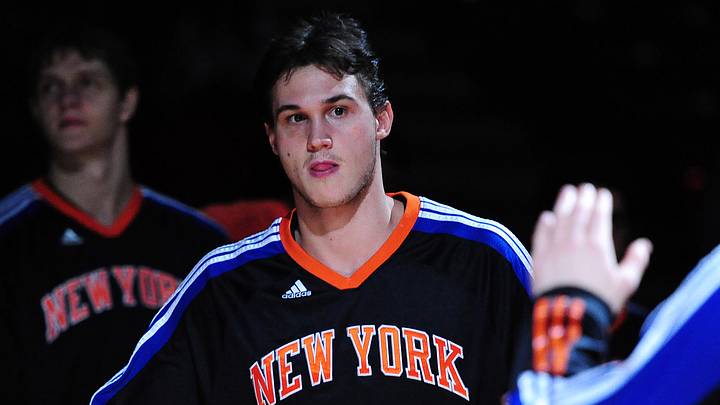
Danilo Gallinari made waves when he boldly stated that he's the "biggest what-if guy in the history of the game." The former New York Knicks forward certainly had roadblocks put in front of him, but critics instantly spoke about the likes of Penny Hardaway, Grant Hill, Derrick Rose, and Bill Walton as more decorated players whose careers were derailed by injuries.
The Knicks have a different view on the conversation, however, as perhaps the biggest losers of the what-if conversation that revolves around Gallinari and the trade that arguably never should've happened—at least not in the form it took.
The Knicks drafted Gallinari at No. 6 overall in the 2008 NBA Draft. He played the better part of three seasons in New York, but was traded in 2010-11 as a part of the package that brought Carmelo Anthony to Madison Square Garden.
The Anthony trade has become one of the most sensitive subjects among Knicks fans who were around for that era, as many have speculated that they could've waited to sign the six-time All-NBA honoree the following summer.
In fact, Anthony himself claims that he told the Knicks in 2011 that they shouldn't blow their roster up to acquire him.
Melo went through A LOT in his trade from Denver to New York 😂
— 7PM in Brooklyn (@7PMinBrooklyn) December 5, 2024
"If they would've called his [James Dolan] bluff ... I woulda been stuck in Denver forever." pic.twitter.com/uINllmi1dC
Unfortunately, the Knicks' notion of Gallinari as a what-if player is different from other teams because their question may have been answered with championship implications.
What if the Knicks didn't blow the roster up for Carmelo Anthony?
Clearly, the necessary assumption for this conversation is that Anthony would've joined the Knicks as an unrestricted free agent in 2011. Working with that in mind, the Knicks would've rolled out one of the deepest and most balanced teams in the NBA.
That starts with Anthony and Amar'e Stoudemire, who had the Knicks above .500 at the time of the trade and earned All-NBA Second Team honors in 2010-11.
On the Stoudemire front, signing Anthony instead of trading for him could've also meant saving the Knicks' amnesty clause. New York used it on Chauncey Billups, who was acquired in the Anthony deal. Had the trade not been made, however, then Billups wouldn't have been on the roster.
Instead, the Knicks would've held onto their amnesty clause and potentially shed Stoudemire's prohibitive salary once his own injury issues capped New York's potential.
Elite depth, amnesty clause would've been available if not for Melo trade
Beyond the amnesty clause is the bigger conversation about how great the Knicks' depth would've been with the players they traded for Anthony. The four key players would've been Wilson Chandler, Raymond Felton, Gallinari, and Timofey Mozgov.
Felton averaged 17.1 points, 9.0 assists, and 1.8 steals in his half-season with the Knicks, while Chandler and Gallinari became pillars of a Nuggets team that won 57 games in 2012-13, and Mozgov emerged as a high-level backup center.
If the Knicks still found a way to sign Tyson Chandler, their depth chart would've been certifiably elite. Felton and Chandler formed a balanced backcourt, Anthony and Gallinari would've been a dynamic duo as three-level scorers who can work on or off the ball, and Chandler and Mozgov would've been an excellent duo to anchor the interior in starting and backup roles.
Compounded by the fact that each of those players thrived in the Knicks' system as selfless and supporting pieces, they could've helped overcome Stoudemire's injury woes and extend the window.
Keep in mind: The players who were traded all had room to grow as players—and most did. Gallinari was 22, Chandler was 23, Mozgov was 24, and Felton was 26. If nothing else, those four could've helped New York sustain their relevance as a contender as other players aged or battled injuries.
Unfortunately, the Knicks instead put all of their hope in Anthony with a depleted roster that they attempted to rebuild with aging veterans. For that reason, Gallinari is right to ask: What if?
 Add us as a preferred source on Google