

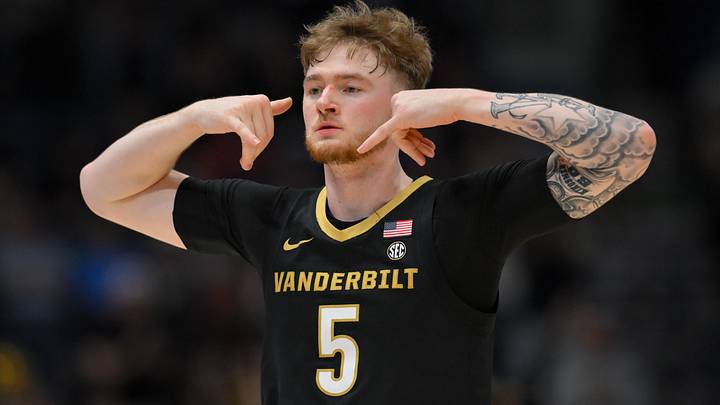
Conclusions are being drawn in droves following the slew of training-camp deals the New York Knicks just signed. Among the many, many takeaways, one is flying below the radar: Tyler Nickel now has a better chance at locking up a roster spot sooner rather than later if, as somewhat expected, this flurry of make-good transactions leads to a Pacome Dadiet trade.
The sheer number of placeholder deals given to perimeter players suggests the Knicks aren’t just in the market for a third big man. Though they technically have two open roster spots, they only have enough room below the second apron to offer one. If they want to dole out a second, they’ll need to offload salary.
Dadiet is the odds-on favorite to get shipped out in that case. Moving Deuce McBride to make room for a minimum signing would be insanity, and shopping him at all is no longer necessary. Even with a surplus of guards, Tyler Kolek has shown too much for New York to simply give up on him.
That leaves Dadiet, and his $3 million salary. Using second-round equity to wipe his money from the ledger leaves enough room for the Knicks to fill what would be their 13th and 14th roster spots with a veteran’s minimums.
It also, however, could arm them with the flexibility to give out a 15th roster spot—so long as there’s a rookie player willing to sign for the minimum.
The Knicks’ math could soon favor Nickel getting a standard contract
It turns out New York might know a guy who fits the aforementioned bill, a certain 6’7” 23-year-old sharpshooter taken with the 47th overall pick.
No need to whip out our calculators, or get lost in spreadsheets. We’ve done the math for you.
The Knicks currently have $3,273,268 in room beneath the second apron. If they jettison Dadiet’s $2,983,680 salary without taking back any money in return, this number jumps to $6,256,948.
Subtract the cost of two veteran’s minimums from that amount at $2,499,421 apiece, for a total of $4,998,842, and New York will be left with $1,258,106 in space below the second apron. This isn’t quite enough to offer a full rookie minimum. That first-year salary runs $1,357,763, which means the Knicks would be $99,657 shy.
BUT!
Contracts get prorated after the start of the regular season. Effectively, Nickel’s minimum salary would dip with each passing day.
Proration assumes a regular season is 174 days long. Nickel’s minimum salary would drop by $7,803.24 on a daily basis. Since the Knicks would be $99,657 shy of the full minimum now, they’d be able to sign Nickel to a standard deal 13 days into the season.
Even the alternative scenario benefits Nickel
The flexibility outlined above wouldn’t exist if the Knicks add just one vet, and keep Dadiet. They’d have to wait much longer to put Nickel on a standard deal.
Even if they dump Dadiet, they may prefer to keep a roster spot open through the trade deadline for optimal flexibility. But going the two-veteran route, without Dadiet, would open the door for Nickel to start on a two-way contract, and be converted to a standard deal as soon as possible.
It’s a path the Knicks might explore, too. Their veteran minimum deals could be flipped to any team if they find a midseason trade requiring extra malleability. Meanwhile, converting Nickel sooner could be a selling point that prevents him from exploring a return to school.
This isn’t a carrot the Knicks should dangle should at the expense of a veteran flier, or more intriguing dice roll. But if shedding Dadiet’s salary gets them two veterans and keeps Nickel in town and available for longer, this scenario shouldn’t just be considered a possibility. It should be Plan A.
 Add us as a preferred source on Google