

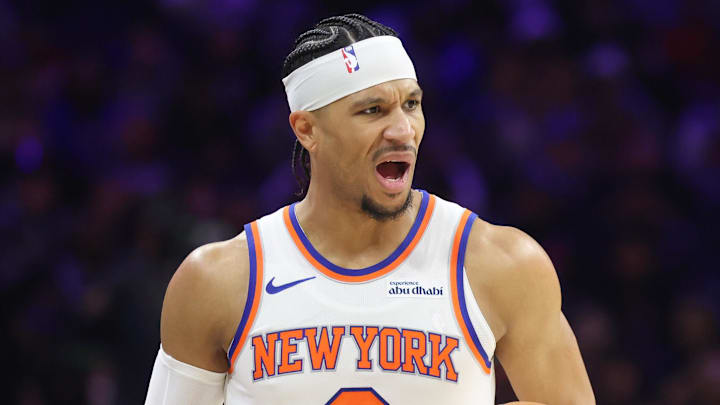
Josh Hart is an incredibly valuable player to the New York Knicks. He’s also an incredibly flawed one. Though the latter often unfairly eclipses the former, the obsession over his faults is hard to shake when watching how the Knicks offense fares with him being guarded by opposing bigs.
That isn’t changing anytime soon. It most certainly isn’t changing just because New York tipped off the month of March with a win over the San Antonio Spurs, who frequently defaulted to having Victor Wembanyama playoff Hart, and roam the floor.
Oh, rest assured, this is among the Knicks’ best victories of the season. The Spurs are a legit team, with even more legitimate defense. Hart himself played quintessential Josh Hart basketball in the second half, perfectly toeing that fine line between unflappable and unhinged.
Still, New York’s solve for its bigs-on-Hart issue isn’t some magical panacea. He set more ball screens against San Antonio than any other game this season—an interesting wrinkle that, upon digging deeper, is hardly a definitive solution.
The Knicks offense struggles when centers defend Josh Hart
Despite pummeling the Spurs by 25 points, the Knicks were a net neutral during the 21-plus minutes Hart and Wembanyama shared the floor. Their offense in this span for the most part wasn’t pretty. They averaged 1.00 points per possession, while shooting just 40.7 percent from two-point range.
New York’s struggles were particularly prominent to begin the game. It lost the Hart-and-Wemby stints by a total of nine points in the opening frame, and averaged a brain-bendingly barf-worthy 0.39 points per possession. The Knicks fared better in the second quarter, but still mustered just 1.00 points per possession during the nearly six minutes Hart was on the floor with Wemby.
It wasn’t until the second half New York started rolling. It averaged 1.36 points per possession during the roughly 10 minutes Hart shared the court opposite Wemby. For context, the league’s best offense notches around 1.21 points per possession overall.
One half doesn’t prove much of anything, good or bad. But the first two quarters were closer to the results these Knicks have churned out all year in similar situations, as The Strickland contributor Shax deftly notes:
Haven't solved anything yet, in-fact they're just beginning to and they don't have me confident in it. Why would I be confident when the numbers say they score 0.92 PPP when teams do it?
— Shax (@ShaxNBA) March 2, 2026
This is a pivotal week to play good teams that will do it and figure it out https://t.co/eqnIUUtRIc
This isn’t to suggest the Knicks are wrong to experiment with Hart as a screener. Just the opposite, in fact. If teams are going to use centers opposite Hart, New York has no choice other than to increase his screening volume. And that in itself is its own problem.
New York still has a Josh Hart dilemma
Not every team will match its center against Hart. For those that do, none of them have anyone like Wembanyama, a one-exterrestrial defensive system unto himself.
Yet, the exact matchups matter less than opponents feeling emboldened to test them. That’s held true even as Hart shoots better from beyond the arc. He is downing 39.4 percent of his wide-open triples this year, up from just 34.1 percent a season ago.
Defenses are going to live with that, as we keep on seeing. Especially when Hart’s converting under 36 percent of his spot-up treys overall. Using him as the screener limits the Knicks’ reliance on his efficiency and volume from deep, but it comes with collateral damage that isn’t clearly worth the payoff.
The floor can still shrink in those situations. When Hart’s screening for Jalen Brunson, that might not matter. If teams switch the action, that should be a win for New York. Sort of. It depends on the big. It’s probably not a caps-lock victory if Brunson has to go up against Wemby, Chet Holmgren, Scottie Barnes, Giannis Antetokounmpo, Isaiah Stewart, etc.
Deploying Hart as the screener also means Karl-Anthony Towns’ isn’t being used as one. That stands to complicate his already-inconsistent offensive usage. KAT attempted just nine shots against the Spurs. That’s all fine and dandy when he’s successfully scrapping and clawing opposite Wemby, and the Knicks win. We are having a different conversation if neither of those things are true.
This says nothing of Mitchell Robinson. Traveling down the Hart-as-a-screener route means the Knicks can’t play them together in those instances. And so, against the Spurs, they didn’t. That won't fly against everyone.
Nothing presented here is unassailable proof that Hart-as-the-screener is sugarcoated farm fecal. The Knicks have every reason to continue exploring it. But painting it as The Answer misses the mark. Their response to Hart getting guarded by bigs remains very much a work-in-progress, and more importantly, a problem that won’t ever have a singular, one-size-fits all solution.
 Add us as a preferred source on Google