

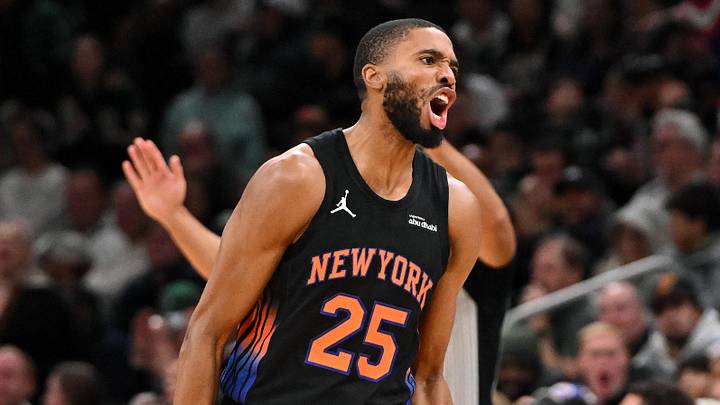
When the New York Knicks signed Mikal Bridges to a four-year, $150 million extension before this season, the decision was met with widespread skepticism, if not outright disdain. Skip ahead to the team’s second straight Eastern Conference Finals appearance, and it looks like the Knicks bagged a bargain, avoided disaster, or both.
Never mind re-litigating the Bridges trade. New York gave up a lot of picks. For now, it remains too many picks. That doesn’t mean the front office needs to be sorry. It doesn’t. Not at the moment. Bridges’ arrival is a huge part of why the Knicks are here, with their best opportunity to reach the NBA Finals since 1999. If winning a title would mean never having to say sorry, then winning the East is at least “okay, it was kind of worth it’” territory.
The reaction to Bridges’ extension, both in the moment and later on, borrowed too much from the impressions of #ThatTrade. They are two separate transactions. Bridges shouldn’t play for the mid-level exception just because New York moved heaven and earth to get him.
If anything, the draft-pick outlay was part of the $150 million calculus. The Knicks gave up that much not just to get Bridges, but because they knew he’d stick around without entering 2027 free agency.
Mikal Bridges could have gotten more money in free agency
Prattle on about how only a handful of squads have space this summer if you must. Teams will chisel out room if it means landing one of the league’s premier three-and-D wings. For as frustrating as the Bridges experience is at times, he still falls firmly into that bucket even on some of his most mediocre-or-worse nights.
If cap-space teams like the Los Angeles Lakers and Chicago Bulls are poking around the Peyton Watson market, you can rest assured they'd have looked at Bridges. Squads a heartbeat from significant cap space, such as the Los Angeles Clippers and Atlanta Hawks, could have done the same.
Up against other bidders, the Knicks would've needed to pony up more dough. A four-year max for Bridges would have run roughly $221.8 million. A five-year max would have cost about $287.1 million.
This isn’t to say Bridges would have fetched a four-year max offer from another team. (Outside squads could have offered up to $212.9 million.) But New York may have needed to come noticeably over the top of that $150 million or include a fifth year if rival admirers entered the running.
The current Mikal Bridges extension is a bargain
Viewed through the lens of a second star, Bridges is bound to disappoint. Treated as the third or fourth complement to bigger names that he’s supposed to be, and his pay grade is right in line with the job description. It’s probably more team-friendly than not.
Bridges is in line to be no higher than the league’s 53rd-highest paid player next season. That top 50 to 60 range is likely where he’ll settle in for the duration of his contract.
Unless you believe he’s not a top-50 player, this deal cannot be considered detrimental. And arguing that point now, of all times, is an extreme reach. His offensive output has dipped in the postseason, largely thanks to his disastrous start against Atlanta. But he’s shooting over 38 percent from downtown, and has spent the entire playoffs capably chasing around guys like Nickeil Alexander-Walker, Tyrese Maxey, and now, James Harden.
Nobody’s arguing Bridges is a perfect player, or that he can ferry an All-Star’s offensive workload. He isn’t, and he can’t. But the notion that the Knicks gave up too much for him, and then gave him a bad contract is ludicrous. Only one of those things is potentially true—and there’s still a chance neither of them is correct.
 Add us as a preferred source on Google