

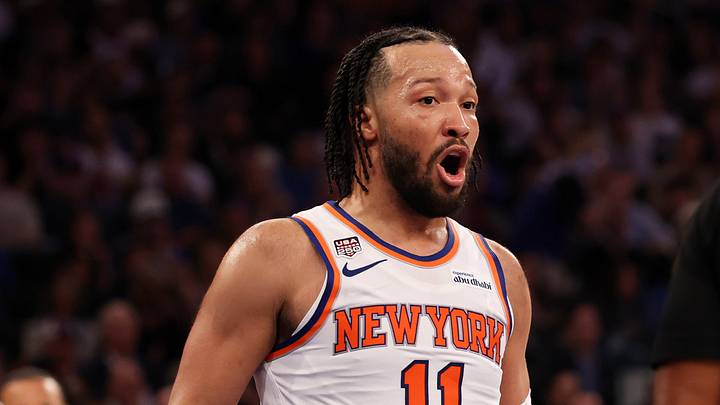
Jalen Brunson has been among the most overworked NBA stars since joining the New York Knicks back in 2022. That wasn’t any less true last year, and after an offseason in which their biggest move was the subtraction of Mitchell Robinson, the reigning Finals MVP could be in line for an identically exhaustive on-ball burden as the team begins its championship defense.
Presuming this, however, suggests the Knicks’ incumbent talent won’t be able to streamline any of Brunson’s workload. And that’s just not true.
Karl-Anthony Towns’ offensive initiation is operable enough to give Brunson a break—a chance to play in different ways, while perhaps sparing his body from the toll extracted by his balletic brilliance going downhill.
This isn’t a theory so much as an observation. The Knicks know it’s possible because they’ve already lived it.
Karl-Anthony Towns already made Jalen Brunson’s slightly job easier
At Towns’ own request, head coach Mike Brown shifted more on-ball responsibility to the big man midway through the first round of the playoffs. New York didn’t indefinitely feature him as a primary hub, but there was a distinct uptick in his touches and time of possession relative to the team’s first three games of the postseason.
During that time, Brunson saw a downtick in his on-ball usage, and by extension, his burden as an on-ball scorer. While he still ranked second in self-created true shooting attempts per 100 possessions, trailing only Shai Gilgeous-Alexander, his volume of 18.7 stands as the fewest he’s needed to generate in the postseason since joining the Knicks.
What’s more, these from-scratch looks didn’t just disappear into the ether. Brunson scored more buckets out of spot-ups, hand-offs and coming off screens.
This past postseason, New York’s captain averaged 7.2 true shooting attempts per 100 possessions as a “spacer,” which refers to the combined total of the aforementioned play types. That number represents a 38 percent increase over 2025 playoffs (5.2 spacing attempts per 100 possessions), an 11 percent increase from the 2024 postseason (6.5), and a 26 percent increase compared to the 2023 playoffs (5.7).
To be sure, Mike Brown’s overarching offensive system deserves a ton of the credit. It put more of an emphasis on using Brunson in different situations during the regular season, dispelling the notion that the Knicks’ lifeline was functionally inflexible.
Still, the added responsibility given to KAT helped the philosophy translate to the playoffs. More critically, it laid the blueprint for New York to simplify Brunson’s life further next season.
New York now has more ways to help Brunson
Funneling additional touches to Towns would typically invite the Knicks to more aggressively stagger their star duo. But around 39 percent of KAT’s minutes last year came without Brunson. There isn’t much wiggle room to ratchet up that share.
Teams want their best players working alongside one another—particularly when, in this case, Brunson and Towns rank as one of the league’s five most efficient two-man combos.
This isn’t about separating them, though. The Knicks have now learned they can buy Brunson more in-game breaks by letting KAT initiate more of the offense.
The proof is in the playoffs. During his minutes alongside Brunson, Towns averaged eight assists per 100 possessions. That is a monstrous uptick over the 4.8 he notched through their joint time during the regular season.
Some will still write this off as a small, immaterial difference. It’s not. When you’ve led the NBA in average time of possession three of the past four years, there is no such thing. Any opportunity you have to diminish your from-scratch grind is meaningful.
The Knicks can now offer that to Brunson—and they didn’t need to make another trade or signing to do it.
 Add us as a preferred source on Google