

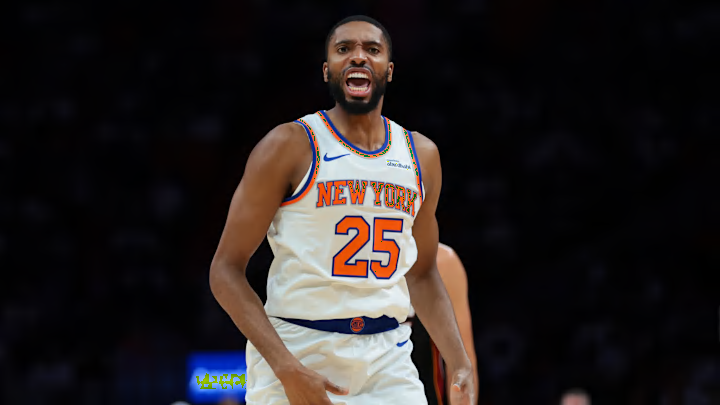
Mikal Bridges can't buy an efficient shooting night. The New York Knicks wing is shooting just 38.8 percent from the field and 30.4 percent from beyond the arc thus far in March, and has shot below 40 percent from the floor in five of his past six appearances.
For as true and frustrating as that may be, critics are growing a bit too loud and dismissive of the overall value that Bridges provides as an unequivocal net positive.
Bridges has found himself in a boat previously occupied by the likes of Tobias Harris and Joe Johnson. Much like Harris and Johnson, he's an unavoidably talented player who provides positive value whenever he takes the court.
Unfortunately, he also shares a distinction Harris and Johnson know all too well as a player who will never escape the shadow of the cost their respective teams paid to acquire or re-sign them.
Perhaps it's just the unfortunate nature of a salary capped league, but Bridges has somehow become underrated despite his contract and the five first-round picks the Knicks gave up to trade for him. Perhaps that made him overrated at the start, but he's played an unavoidable role in elevating New York to contender status.
Overlooking that fact now because of a cold stretch during a season in which his impact hasn't been defined by scoring is tantamount to losing the plot.
Mikal Bridges is still a net positive despite incessant criticism
Bridges is currently averaging 14.8 points, 4.1 rebounds, 3.9 assists, 1.4 steals, 0.8 blocks, and 2.0 three-point field goals made on .486/.372/.821 shooting. He's one of just two players currently hitting each of those season averages while shooting at a clip of at least .450/.350/.800, with the other being All-Star guard Tyrese Maxey.
Though many expected more of Bridges from a scoring perspective, it's imperative to note that the Knicks are No. 3 in the NBA in offensive rating with this very formula for success.
Jalen Brunson and Karl-Anthony Towns are the clear-cut first and second options from a scoring perspective. OG Anunoby has steadily emerged as the third star in the scoring department. Bridges then slots in as an efficient and effective fourth piece of the puzzle.
All of this is achieved while the Knicks are still tasked with finding 10.3 shots per game for Miles McBride, 9.2 for Josh Hart, and sufficient opportunities for players whose scoring is directly tied to their overall value to the team, including Jordan Clarkson and Landry Shamet.
Despite helping to clear a path for the other scorers on the roster and posting an eFG% that's 2.3 percent higher than the league average, Bridges can't seem to find any praise.
Mikal Bridges contributes to the sum of parts, but critics focus on individual numbers
Clearly, Bridges playing at the level he's been performing at in March isn't going to prove sufficient. When discussing the overall reality of the Knicks' rotation, however, he's an invaluable contributor to a team that wins as the sum of its parts.
New York has a surplus of undersized guards and two high-level bigs with well-documented weaknesses, thus making the few wings on the roster undeniably essential.
With Anunoby, Bridges, and Hart, the Knicks can trust three different wings to not only provide offensive production, but defend at a high level. The only other player on the roster who's taller than 6'4", isn't a center, and can be reasonably asked to defend forwards is Mohamed Diawara—who didn't begin to receive consistent playing time until February.
Despite the fact that Anunoby, Bridges, and Hart offset those issues by functioning as a complementary unit that strengthens one another's contributions and binds this team together, Bridges' game continues to be picked apart.
In the process, all of the positives are overlooked.
Knicks are a better team with Mikal Bridges than without him
Towns, for instance, sees his true shooting percentage increase by 5.2 percent when Bridges is on the court. Anunoby goes from shooting 31.1 percent from beyond the arc without Bridges on the court to 38.5 percent with him.
Hart experiences a similar shooting phenomenon at 41.3 percent from beyond the arc when Bridges is on the floor and 30.3 percent when he isn't.
Furthermore, the Knicks rank in the 78th percentile in net rating, the 80th percentile in offensive rating, the 77th percentile in eFG%, and the 71st percentile in defensive rating when Bridges is on the court. Their offensive rating increases when he's come off the court, but they drop to the 55th percentile in defensive rating and the 59th percentile in eFG% without him.
That seemingly displays how invaluable Bridges is to the team's success and efficiency on both ends of the floor. It just doesn't fit the narrative.
Individually, it's also become too convenient to downplay Bridges' impact despite the facts. According to Basketball Index, he ranks No. 2 in the NBA in off-ball chaser defense. He's also in the 92nd percentile in perimeter isolation defense despite arguably playing outside of his ideal role as a featured point of attack defender.
Bridges needs to right the ship as a shooter before the playoffs begin, but downplaying his value because of his scoring average completely misses what he provides to the Knicks.
 Add us as a preferred source on Google