

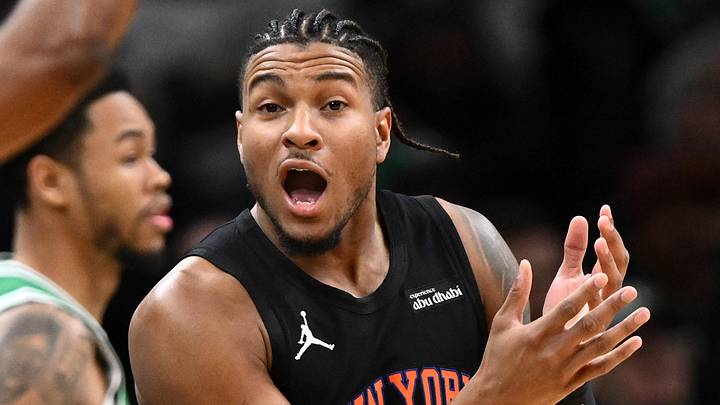
The cost of re-signing Jose Alvarado (player option) and Landry Shamet, as well as potentially extending Deuce McBride, is among the New York Knicks’ most pressing offseason issues. On the heels of Collin Collespie agreeing to stay with the Phoenix Suns, the reigning champs now have an idea of what it could—and just as importantly, what it shouldn’t—take to keep the band together.
Gillespie is signing a four-year, $48 million deal to stick with the Suns, according to ESPN’s Charania. This checks in noticeably below full mid-level-exception money that many believed he could command. A four-year agreement at that price point would clock in around $65.1 million.
The Knicks should absolutely care about this development. In fact, they should be applauding it. Because if an average annual value of $12 million is what’s required to retain Gillespie, New York should have an easier time negotiating team-friendly deals with Alvarado, Shamet, and even McBride.
Collin Gillespie’s new contract is a Knicks-friendly precedent
Though Gillespie isn’t a perfect analog for any of the Knicks’ own guards, this is sort of the point.
At 26, he is younger than Shamet and Alvarado, and just a hair older than McBride. More critically, he started 58 games for a playoff team from the Western Conference, averaging 12.7 points and 4.6 assists in over 28 minutes of action.
McBride came closest to matching Gillespie’s court time (26.3 minutes per game), but he, Alvarado, and Shamet are all reserves. Not one of them, meanwhile, sniffed the on-ball reps with which Gillespie was saddled.
While Deuce, Shamet, and Alvarado all have Phoenix’s floor general beat on the defensive end, he checks a more desirable box with his offensive initiation. If he can’t suss out an offer worth the full non-tax MLE, it doesn’t bode well for Alvarado and Shamet this summer, or McBride next year—which is fantastic news for the Knicks.
Collin Gillespie’s new contract is a Knicks-friendly precedent
Granted, Gillespie’s contract will be a moot comparison point if the Knicks aren’t willing to enter the second apron. The collateral damage of that stance is, at minimum, the inevitable exit of Mitchell Robinson.
Fortunately (in this case anyway), James Dolan isn’t a reliable source for much of anything. He could have misspoke, been trolling, or trying to send a veiled (and rather ineffective) message to the league office.
Even if the Knicks aren’t willing to break the second-apron threshold, the Gillespie deal lends hope to them figuring out how to keep Alvarado and Shamet. Alvarado no longer seems as likely to blow past his $4.5 million player option value if he hits the open market. Again, defensive energy and all, he doesn’t typify the desired floor-general archetype.
Shamet is a more complicated case. You don’t pay him with the intention of putting him on-ball too often. His value is rooted in his shooting gravity, and try-hard defense. Yet, those skills would carry far more value if he were 6’7” instead of 6’5”.
On top of that, if Gillespie can’t get more than $12 million per year now, it increases the chances that McBride encounters a less-lucrative market next summer. His defensive freneticism can be somewhat muted by his size, and he’s less suited to running the offense than Alvarado. Contracts like Gillespie’s could make it easier for the Knicks to extend McBride at a palatable number beyond 2026-27.
Indeed, it’s too early for the Knicks to breathe a sigh of relief. At the very least, though, the first contract of NBA pre-agency is clarity they need—and the kind they can celebrate.
 Add us as a preferred source on Google